
The story behind Impro Supreme
How years of training, influence and practice shaped this physical approach to improvisation.
Why everything starts in the body
Impro Supreme didn’t appear overnight. It grew out of years of searching, training, performing — and being shaped by a handful of exceptional teachers. Underneath it all was a need: for clarity, for depth, for something real in improvisation. Something that felt alive from the inside.
What follows is the path that led there: the moments that shifted my direction, and the ideas that still guide my work today.
⸻
Where it really began
Discovering improvisation in Paris
I discovered improvisation in Paris almost by accident. It felt like a breath of fresh air — a room of strangers becoming a group in minutes, a sense of generosity and play that surprised me every time. I realised I could make people laugh with almost nothing: a gesture, a sound, a fragment of intention.
It was liberating. A door opened.
The early dissatisfaction
But after a few years, something felt incomplete. I was performing a lot, teaching, going to festivals, doing everything an improviser does… and yet I sensed a deeper form of improvisation that never appeared. The verbal games, clever lines and repeating patterns didn’t touch what I was looking for.
Down-to-earth simplicity and truth. Something as unmistakeable as raising one’s arm.
⸻
Meeting the teacher I didn’t know I was looking for
First contact with Ira
I met Ira Seidenstein in a café in Paris in 2008. Within minutes it was obvious he saw things I didn’t yet know how to see. A few days later, in a three-hour workshop, he gave me his “secret” to improvisation: a pause, a gap, and a simple binary choice.
It was almost annoyingly simple — and exactly what I had been missing.
The yearly trips to Australia
Two years later, I was in Brisbane at Ira’s Quantum Clown Residency. The work was confronting, personal, and entirely honest. I returned four years in a row. It stripped away habits and assumptions I hadn’t realised I was carrying.
More than anything, Ira taught me to see — to notice what is actually happening, in myself, in others, in the space. That shift became the foundation of my work. Our connection has continued ever since, both as mentorship and friendship.
Long-term impact
That training reshaped everything: how I improvise, how I perform, how I teach. Over the years I organised numerous workshops for Ira in Paris, partly to keep the work alive around me, and partly because I knew others needed to encounter it too.
⸻
Three important dance teachers
Mary Overlie
Two weeks with Mary Overlie in London in 2019 changed the way I perceive physical reality on stage. Her combination of clarity, humour and radical perception opened a door that has stayed open ever since.
Julyen Hamilton
With Julyen Hamilton, composition became musical and poetic. Ten days at a time — twice — were enough to show me what group improvisation can become when everyone listens at a deeper level.
My ballet teacher
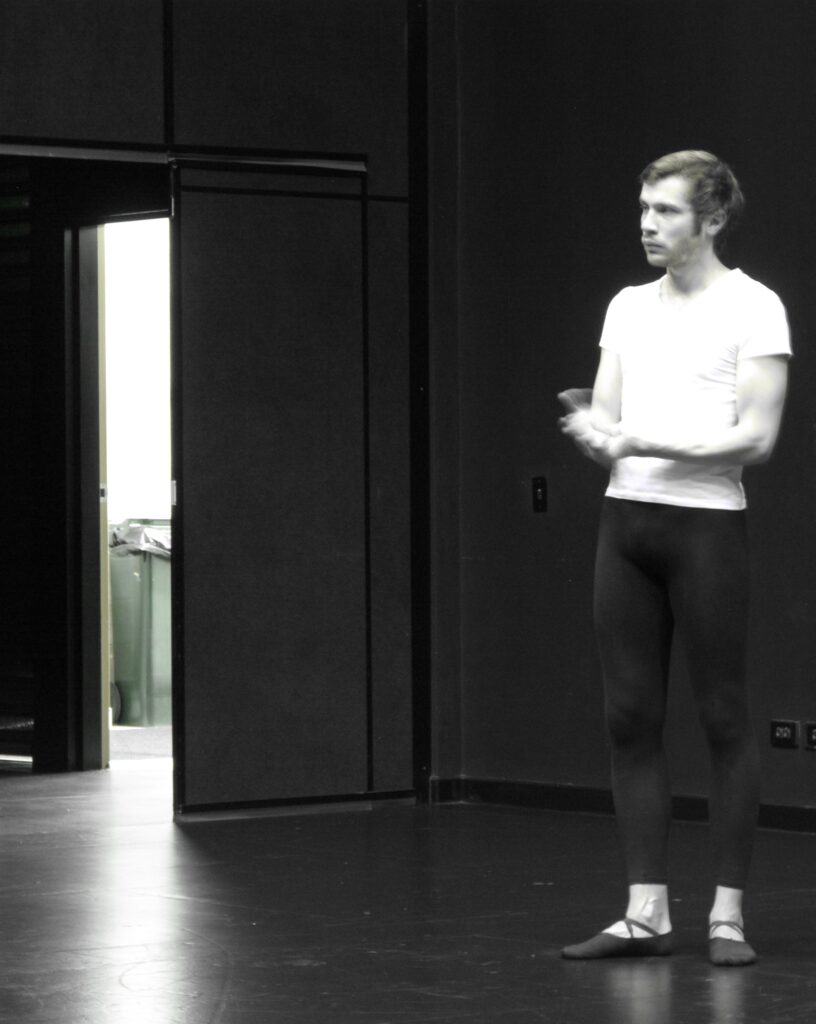
For nearly fifteen years I trained with the exceptional ballet teacher Michèle Bonneau. Classical technique, strict discipline, relentless detail, and a lot of laughter. That training grounded me and gave me a physical stability that still supports everything I do.
Finding my own way on stage
The turning point: performing solo
The major shift came when I began performing solo. I took the exercises I practised alone and placed them directly in front of an audience — nothing to hide behind, nothing to protect me. Just my body and my imagination in the moment.
That became Plan C, a project that stayed with me for more than a decade. Performing across Europe, Australasia and North America confirmed what I had already sensed: physical improvisation was the place where everything came together.
The ongoing solo practice
Over time, the solo work developed its own tone — part mime, part clown, part improvised theatre. Someone once called it “romantic clowning.” What I valued was its honesty: one body, one moment, one audience. The work revealed what I actually wanted to do on stage.
⸻
Teaching across the world
Paris beginnings
Teaching started as a complement to performing, then quickly became central. Early on, I realised I wasn’t interested in passing on tricks. I wanted to offer clarity — something people could actually use, something that made their work more grounded and alive.
Europe and beyond
Invitations followed from festivals, schools and small companies. Everywhere I went, the same pattern appeared: people wanted to work with their whole being — body, attention, imagination — not just storylines and verbal improvisation. And almost everywhere, people underestimated the diligence it takes to consistently go deeper in their own artistic universe.
What teaching revealed
Teaching became its own research. Every group showed me something new. I learned that clarity is a form of generosity: when principles are simple, people find their own way. It brings out their courage. That understanding shaped the workshops and trainings that would eventually become Impro Supreme.
⸻
Putting it all together
The central insight
The centre of everything — performance, creation, presence — is the link between body and imagination. Not story. Not ideas. Not cleverness. When the body is engaged, the imagination responds. And when imagination responds, meaning appears.
What makes this approach different
Improvisation is not mysticism. Not talent. Not personality. It’s physical, perceptive, practical. Something you train. Something you build. That’s what Ira’s method gave me, and what I continued refining until the approach became my own.
A practicable philosophy
Improvisation begins long before ideas. It begins in sensation, attention, and the willingness to act honestly. When attention is simple, things appear. When the body is alive, imagination follows.
⸻
Why I created Impro Supreme
What was missing
By 2010, it was obvious that most improvisation training left out the essential: the body, presence, clarity, individuation. Plenty of fun — but little depth. People could “do scenes,” but many lacked a personal foundation as performers.
I wanted a place where individual training mattered. Where the real work could happen.
What Impro Supreme offers today
Impro Supreme began as a personal project — a name, a place to gather what I was learning. Over time it became a method: physical, imaginative, attentive. A way of training that performers can return to again and again.
Group work is wonderful, but individual work is indispensable. You cannot hide from yourself there, and that is where the real progress happens.
The throughline
Looking back, the throughline is simple: presence, clarity, honesty, embodied imagination. Every important teacher and every breakthrough pointed in the same direction — toward reality, toward sensation, toward meaning.
⸻
Where it leads
If there is one thing I trust, it’s that expression begins in the body: in sensation, attention, and the willingness to act honestly. That’s where Impro Supreme comes from, and that’s where it continues to go.